
Burnout 2 Point of Impact
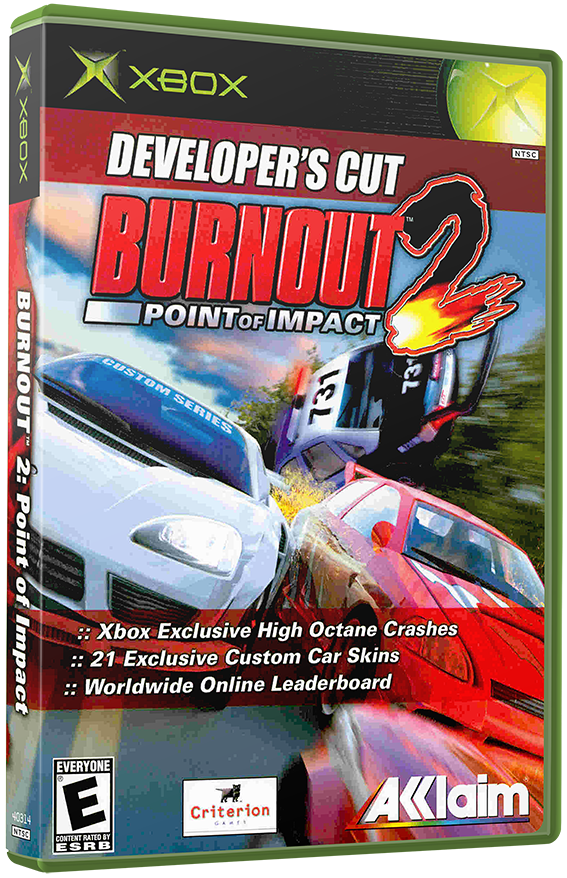


Game Type: Released
Max Players: 2
Genre: Racing
Developers: Criterion Games
Publishers: Acclaim Entertainment
Cooperative: No
PEGI: U
Game Overview
Burnout is a street racing game focused around speed and crashing. Unlike many games which focus on closed course driving, you get to drive through cities with real traffic and city infrastructure. Designers have built an entire city and surrounding areas, and implement the race courses throughout the county's streets. As a result, many times certain parts of race-courses interlace with other parts of other races. As well, instead of encouraging strategic driving and safe driving, Burnout strongly encourages offensive driving. Driving on the wrong side of the road, barely missing passing traffic, drifting, and jumps all add to your boost meter. Speed boosts and jumps aid your attempt to dive past buses, trucks, and anything else that gets in the way. The more offensive and dangerous your driving is, the more boost you get! The game also includes a "Crash" mode, in which the players earn points by causing damage to other vehicles. Crash mode is generally seen as the "puzzle" aspect of Burnout, as each scenario's vehicles are not randomised. This adds a layer of strategy, as well as trial and error, to determine which angle, speed, and point of impact is required to obtain maximum points. The points are given in cash dollars.
Introduction to Burnout 2: Point of Impact
Burnout 2: Point of Impact is a high adrenaline arcade racing game released for the original Xbox in 2002. The game builds upon the success of its predecessor by enhancing core gameplay features and introducing new game modes, vehicles, and locations. Developed by Criterion Games, Burnout 2 is renowned for its thrilling speed and realistic crash physics, immersing players in intense and dangerous driving environments. With a unique focus on reckless, high speed racing, players are encouraged to take risks, drift, and perform near misses to build up boost meters and outpace opponents. Set across varied and visually captivating locations, the game requires players to master sharp turns, dodge traffic, and push their reflexes to the limit to avoid disastrous crashes.
Plot and Background
The plot of Burnout 2: Point of Impact is minimalistic, primarily serving as a backdrop for the arcade style gameplay. Players assume the role of a street racer who competes in a series of illegal races across the United States. These events are staged in a range of American locales, from bustling city streets to deserted highways and coastal roads. The player character's motivation revolves around proving their skill in these increasingly dangerous events, risking life and limb to gain fame, speed, and glory. Although the game lacks a traditional storyline, each race presents a new set of challenges that push players to their limits as they attempt to dominate the road and outmanoeuvre rivals.
Gameplay Mechanics
Gameplay in Burnout 2 centres around high speed racing with an emphasis on risk and reward. Players are encouraged to drive aggressively, building up a boost meter by drifting, narrowly avoiding other vehicles, and performing stunts. The boost meter is an essential aspect of the game, as it allows players to activate a speed burst, propelling them forward at breakneck speeds. However, this mechanic also introduces a greater risk of crashes, as players must navigate heavy traffic and sharp corners with little margin for error. The game’s physics engine was praised for its realistic depiction of collisions, making crashes both visually stunning and consequential, as players lose valuable time recovering from wrecks.
New Modes and Features
Burnout 2: Point of Impact introduced several new game modes that expanded its replay value and offered unique challenges. One of the most popular additions was the Crash mode, where players aim to create the most spectacular accidents possible. By strategically launching their vehicle into busy intersections or crowded roadways, players could maximize damage and earn points based on the chaos they caused. Other modes include Pursuit mode, in which players take on the role of a police officer attempting to apprehend fleeing suspects. These varied game modes give players multiple ways to experience the game's core mechanics, ensuring that gameplay remains fresh and engaging throughout.
Vehicle Selection and Customization
The game boasts an extensive roster of vehicles, each with distinct handling characteristics, speed capabilities, and durability. Players begin with a limited selection of cars, gradually unlocking new models by completing challenges and achieving high scores. Vehicles range from compact cars to muscle cars, sports vehicles, and even police cruisers, each designed to offer unique advantages and cater to different playstyles. While Burnout 2 lacks deep customization options, each car's visual design and handling provide a sense of personality. The range of vehicles ensures that players can experiment with different driving styles and find the car that best suits their racing strategy.
Graphics and Sound Design
Burnout 2: Point of Impact was notable for its impressive graphics and detailed environments, setting a new standard for visual quality in racing games at the time. Each track is packed with visual details, from urban billboards to natural landscapes, creating an immersive experience that complements the high speed action. The game also features a dynamic soundtrack that enhances the tension of races, with adrenaline pumping music and realistic sound effects for engine noises, tire screeches, and crashes. These audio visual elements work together to heighten the intensity and make each race feel as exhilarating as possible, keeping players fully immersed in the game's fast paced world.
Challenges and Progression System
Burnout 2's progression system is designed to reward players for mastering the game’s various mechanics and achieving high scores. As players advance, they unlock new cars, tracks, and modes, each offering additional layers of difficulty and complexity. The game encourages players to improve their driving skills, particularly in managing boost and avoiding crashes, to achieve optimal performance in each race. With each level, players encounter more aggressive AI opponents and complex track layouts, requiring quick reflexes and strategic thinking. This progression system keeps players engaged, continually challenging them to refine their technique and complete increasingly difficult events.
Track Design and Environments
The game features a wide variety of tracks that are inspired by real world locations across the United States. From crowded urban streets to winding mountain roads and sunny coastal highways, each track offers unique environmental hazards and layout challenges. These designs encourage players to master each location’s quirks, whether it's tight turns, heavy traffic, or hazardous weather conditions. The environmental diversity keeps gameplay fresh, requiring players to adapt their strategies to handle each track's specific challenges. The attention to detail in the track design and the distinct atmosphere of each setting contribute to the game's immersive quality and replay ability.
Critical Reception and Legacy
Burnout 2: Point of Impact received widespread critical acclaim upon release, with reviewers praising its exhilarating gameplay, innovative crash mechanics, and high quality graphics. Its focus on speed and risk taking, combined with the addition of modes like Crash and Pursuit, set it apart from other racing games of the time. The game’s success cemented Burnout as a popular franchise, leading to future instalments that expanded on its core formula. Today, Burnout 2 is remembered as a pioneering title that influenced the arcade racing genre, leaving a lasting legacy as a game that celebrated both the thrill of speed and the spectacle of destruction.
Read or download in a new browser window (PDF)

