
Burnout
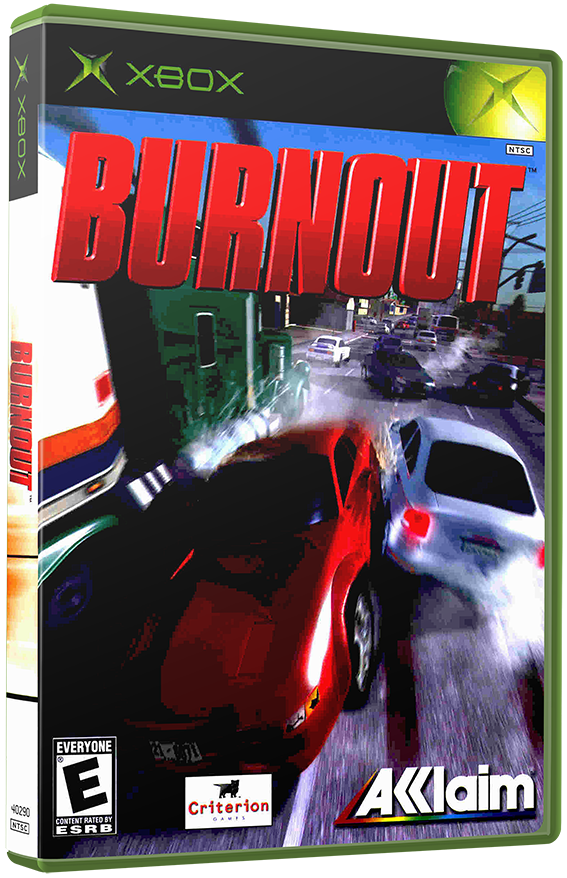


Game Type: Released
Max Players: 2
Genre: Racing
Developers: Criterion Games
Publishers: Acclaim Entertainment
Cooperative: No
PEGI: U
Game Overview
The main gameplay mode in Burnout is the Championship mode, which is a selection of events with three or four races in each. Here the player competes against three other cars on various courses styled on European and American locations. Each event gets harder and requires the player to use faster cars to reach first place. After completing each event, a Face Off challenge is unlocked which in turn unlocks a new car if won. Other modes include single race, time attack, and 2 Player. Single race is a mode where the player races against three opponents. In a time attack, the player must finish a lap in a certain amount of time.Each location is connected in "Sprints", so hypothetically one could drive from River City Paris and end up in Harbour Town the Costa del Sol in a matter of seconds. On completion of all the 'European' and 'American' events, two 'endurance' modes are unlocked, allowing the player to drive through both these locations in a single race, as well as the three American locations. Completing these can take between 15 and 20 minutes. Each location has a distinct collection of traffic that distinguishes one continent from the next; e.g. American taxi cabs versus European taxi cabs and so forth.
The Core Concept of Burnout
Burnout, developed by Criterion Games and released on the Xbox, canters around high speed street racing with a focus on risk based driving. Unlike traditional racing games, Burnout encourages players to push their driving skills to the limits by performing dangerous manoeuvres like drifting, near misses, and weaving through oncoming traffic. The game rewards players for taking these risks, which fill a boost meter that allows vehicles to reach extraordinary speeds. Burnout combines these mechanics to create a unique experience, where risk and reward define the gameplay and contribute to intense, adrenaline fueled races. The game was designed to immerse players in a sense of speed, chaos, and excitement rarely seen in racing titles.
Gameplay Mechanics and Risk Elements
In Burnout, the gameplay is centred around high stakes racing with an added emphasis on risky behaviour, requiring players to push boundaries to maximize their chances of winning. Each race track is filled with traffic, intersections, and other hazards, pushing players to make split second decisions to avoid collisions. Risk taking is integral, as it fills the player's boost meter, which is essential for maintaining a lead against opponents. Skilled players can chain risky moves together, creating a flow that keeps them ahead. The blend of aggressive driving and careful navigation creates a dynamic gameplay experience where players must balance speed with control.
Boosting and Speed Mechanics
A key feature in Burnout is the boost system, which allows players to accelerate beyond the normal speed limits. The boost meter fills when players perform risky actions like narrowly avoiding traffic, drifting around corners, or driving on the wrong side of the road. Once full, players can activate their boost to gain a significant speed advantage. However, this high speed boost also increases the risk of a crash, requiring sharp reflexes and quick thinking. Burnout’s boost system rewards players who master its risk mechanics, allowing them to stay ahead of the competition and push the limits of what is possible in a racing game.
The Crash Mode and Destruction Mechanics
Burnout introduces a unique Crash Mode, where players are encouraged to cause as much damage as possible by driving into intersections and triggering chain reaction crashes. This mode shifts focus from traditional racing to creating controlled chaos, as players aim to maximize destruction for high scores. Points are awarded based on the damage caused to other vehicles, and players can aim for specific targets or attempt to create multi car pileups. The crash mode adds a layer of strategy, as players must consider the timing, location, and angle of impact to maximize their score. This mode became a standout feature, showcasing Burnout's creative take on vehicular destruction.
Track Design and Environments
The tracks in Burnout are meticulously designed to enhance the sense of speed and danger, with urban, suburban, and industrial settings that feature sharp turns, narrow roads, and busy traffic. Each environment presents unique challenges, encouraging players to adapt their driving style to different scenarios. For instance, tight city streets require precise navigation, while open highways allow for maximum speed and risky overtakes. The track design incorporates strategic placement of traffic and obstacles to test players' reflexes and decision making. These environments provide variety in each race, making every track feel distinct and demanding in its own way.
Opponent AI and Competition
Burnout's AI controlled opponents contribute significantly to the game’s challenge and excitement, with aggressive driving styles that force players to stay alert. Opponents do not simply follow a predictable path; instead, they adapt and respond to the player's actions, competing for risky moves and actively trying to outmanoeuvre the player. This competitive AI design heightens the intensity of each race, as opponents pose a constant threat, ready to take advantage of any mistake. The AI's unpredictability mirrors the chaotic nature of street racing, making each race feel fresh and intense. Players must carefully strategize to maintain an edge over these relentless rivals.
Visuals and Sense of Speed
Burnout’s visuals were ground breaking for its time, with detailed car models, realistic lighting, and dynamic environments that enhance the immersive experience of high speed racing. The game’s use of motion blur, combined with realistic sound effects, heightens the sensation of speed, making players feel as if they are racing at breakneck velocities. When boosting, the screen shakes slightly, and the edges blur, creating a tunnel vision effect that adds to the sense of adrenaline. These visual elements, combined with fast paced action, ensure that players are fully immersed in the high risk, high reward racing experience that defines Burnout.
Sound Design and Immersive Audio
The audio design in Burnout plays a crucial role in delivering an immersive racing experience. Engine sounds, tire screeches, and the roar of traffic surround the player, bringing the intensity of each race to life. The game’s soundtrack complements the high energy gameplay, with tracks that match the fast paced nature of the races. Sound effects intensify during crashes, with loud, metallic impacts that highlight the destruction. The boost sound effect is particularly notable, signalling a burst of speed and elevating the thrill of pushing the car to its limits. Burnout’s audio design works harmoniously with its visuals, creating an engaging atmosphere.
Legacy and Influence of Burnout
Burnout left a lasting impact on the racing game genre, setting a new standard for action oriented racing games with its emphasis on risk and reward. Its innovative mechanics inspired future games, including subsequent Burnout titles that expanded upon its core concepts. Crash Mode became a popular feature that differentiated Burnout from other racing games, as it encouraged players to explore the game in a new way. The success of Burnout showcased the potential for arcade style racing games to offer more than traditional race formats, influencing other developers to incorporate high octane action elements into their racing titles. Burnout remains a beloved classic, remembered for its unique gameplay and lasting contributions to the genre.
Read or download in a new browser window (PDF)

